
-
 Technology and Design: The European PerspectiveChiara Benedettini's Interviews with Leading European System Integrators
Designing Experience:
the Role of the Audiovisual Consultant in the Spaces of Tomorrow
Aurélien Grocq
LMI Audiovisuel

LMI Audiovisuel is one of the technical design studios that has helped shape this profession in France: 15 professionals based across Paris, Bordeaux, Montpellier and Lille, with a focus on the Corporate sector and an agnostic approach towards manufacturers and integrators. At ISE 2026, we met Aurélien Grocq, Associate Director: "Our work resembles that of an architect", he told us, "we support our clients in defining technical solutions, drafting specifications, selecting integrators and following through to project completion."
Chiara Benedettini – Can you tell us about one or two projects you consider representative of your work?
Aurélien Grocq – A recent example that is particularly close to my heart involves the municipality of Évry-Courcouronnes in Île-de-France. The brief was to design a multipurpose room for Municipal Council sessions, civil wedding ceremonies and, when needed, public events hosting up to 400 people. What made this project special is that we were brought in very early, working side by side with the architects and interior designers from the very first phases, focusing on the real uses of the space and how technology could best serve them. This allowed us to integrate multimedia as a structural part of the architectural project. All the furniture was designed to be removable and reconfigurable: the room transforms according to its use, thanks to a movable partition that allows the spaces to be separated or combined. It is a very representative example of our approach.
CB – It is not common for an audiovisual consultant to be involved so early in a project. Who deserves credit for this vision?
AG – It was the architecture firm SAFA itself that reached out to us, right from the very first phases of the project - which, it has to be said, is not the norm. For an intervention of 600 to 800 square metres, a relatively modest space, the project team was complemented by three specialist profiles: an acoustician, a lighting designer and an audiovisual consultant. This choice to integrate all technical expertise in a coordinated and early manner is, in my view, one of the main reasons for the project's success.
Nicola Franceschi – In this case, technology and design truly worked together. What is your vision on this topic?
AG – Technology is part of design: every project starts from two fundamental elements - space and use, the available surface and what you want to do in that environment… together, they define the experience you want to offer. Personally, I do not oppose technology and design: I see them in a necessary dialogue, even a collaboration. The multimedia consultant must talk with the architect from the very beginning, just as the carpenter must coordinate with the integrator, so that in the end design and technology work together and produce the desired experience. An experience measured not only by technical efficiency, but also by wellbeing - which fundamentally means making the user feel at ease in the space. And this is where furniture, acoustics and lighting play a determining role.
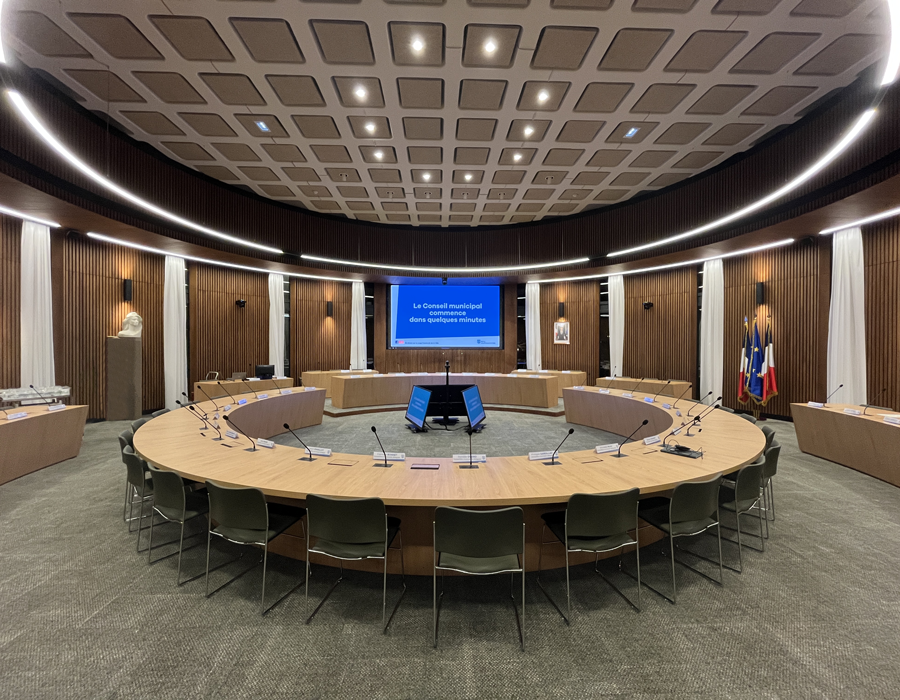
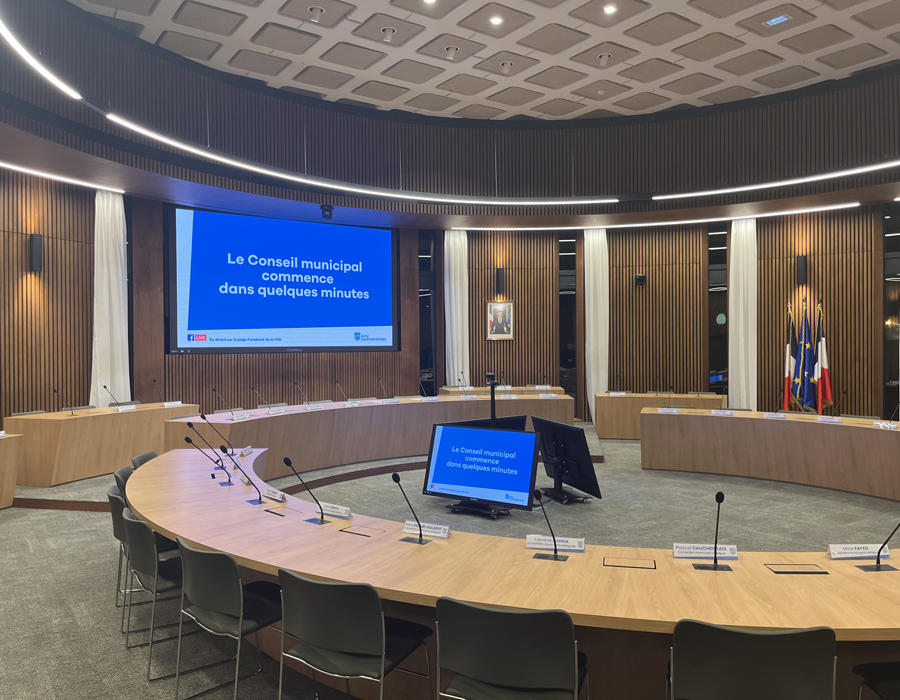
1.-2. Some images of the multipurpose room at the Municipality of Évry-Courcouronnes, Île-de-France.
NF – What is the role of the multimedia consultant in terms of the user experience of a space?
AG – User experience is often the reason we choose a place. Let's go back to the concrete example of the Municipal Council chamber in Évry: this is where decisions are made for the life of a city. If the councillors do not feel at ease in that space, decisions are made under unfavourable conditions. That is not a minor detail. Our role is to be increasingly present alongside architects, to ensure that spaces are not only beautiful - and beauty matters, as does durability - but that they work. Working means seeing the screen correctly, hearing the person speaking from the other side of the room, reading your documents without glare on the screen. All these elements determine the quality of the experience. Audiovisual is rightly becoming a critical factor: if it works, people can truly benefit from the services the space offers; if it doesn't, that's an opportunity - and money - lost.
CB – Going on with this topic: do your clients come to you with specific requests in terms of user experience?
AG – Clients rarely have a clear idea of how to achieve their goal - it is not their job to know whether they need one large screen or several smaller ones, or which technical solution to adopt. But they know very well what they need. Our mission is to start from there. In the Évry project, for example, we asked: how do you vote in this room? Electronically, by show of hands, with paper ballots? And how would you like to do it in two or five years? From those answers, we proposed functionalities that could evolve with their ways of working, always assessing costs and integration possibilities.
NF – Do you think the integration of technology and design plays a role in the multifunctionality of spaces?
AG – It has been a very strong trend for the past four to five years, particularly in cases where the future use of a space was uncertain. Today we have returned to a more balanced approach - there are spaces with a fixed purpose, such as a dedicated council chamber - but the demand for flexibility in large spaces remains high. Conference room, meeting room, cocktail reception, training: the same surface must be able to accommodate very different uses, both in companies and in public institutions. The difference from the past lies in the technological complexity now required. The multipurpose room of a small village used to have a microphone, a few amplifiers and a screen: that was enough. Today in that same room you vote electronically, hold video conferences, manage automatic camera systems. The expected level of quality is far higher.
NF – What is the role of AV professionals in designing truly multifunctional spaces?
AG – Our role is central, but we are not alone: the architect and the other consultants must also bring a vision of durability. A seemingly trivial example: the choice of materials for a simple floor hatch for cable routing will matter if it must withstand thousands of use cycles and repeated movement of furniture. This kind of thinking must be shared across the entire project team. The same applies to technological infrastructure: we already know that technology will not last for decades, but the physical infrastructure - cabling and networks - will need to be sized to last at least 15 to 20 years, and designed to accommodate technologies that do not yet exist today. Designing for the future means leaving room for what we do not yet know we will need to do.
CB – In France, is the role of the multimedia consultant well defined and established?
AG – Until 10 to 15 years ago, consultants were rarely present in France: the consulting culture comes primarily from the UK and the United States. In recent years it has spread to France, Belgium and Germany, and is beginning to emerge in Southern Europe. It is important to build networks, including at an international level.
CB – Visiting this edition of ISE, did you spot technologies and solutions that you think will stay with us in the coming years?
AG – The obvious answer would be artificial intelligence - it is everywhere, in speeches and press releases. But I have to be honest: I was a little disappointed on that front, because compared to previous years there has been no significant leap forward. What did strike me, however, were LED screens with textured surfaces, capable of reproducing materials and finishes - stone, marble, wood - when not in use. We saw this across several stands, a genuine trend that opens up a new design possibility: rethinking corporate reception halls, hotel lobbies, all those spaces where today you find either a black screen switched off or a large panel permanently lit. Having a surface that, when not broadcasting, becomes a design element integrated into the architecture - that is exactly the kind of solution that changes the dialogue between technology and space.